What is Tarot?
Tarot is a card game originating in 15th century Italy, which is played using the Tarot playing card set.
While only used in playing card games for many centuries (and it is still played like this in many parts of europe nowadays), in the 18th century it developed into a card set used for divination and fortune telling.
I don't know much about the original Tarot game, so I won't go into much detail about it here. I can go a bit deeper into the Tarot as a cartomancy practice.
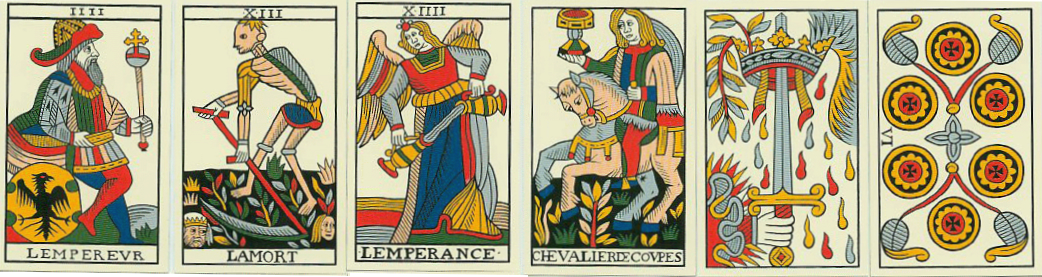
Much like a regular deck of playing card, the Tarot deck is made up of four suits, which contain number cards (Ace-10) and 4 face cards (compared to 3 in the regular card deck).
Unlike regular playing cards, the Tarot also includes 21 Trump cards, which feature archetypical figures and concepts.
Lastly, the deck contains a the Fool, which is also found in regular playing cards. In the cartomancy tradition, these 21 Trumps and the Fool (denoted as number 0) are combined into the Major Arcana. The four suits are grouped together as the Minor Arcana.
These can vary in modern variants, but are all based on the same original layout:
Swords (associated with the mind and the element air), Cups (associated with emotions and the element water), Wands/Staves (associated with ambition and the element fire), and Coins/Pentacles (associated with physical matters and the element earth).
Lastly, the face cards of each suit (also called the Court cards) are made up of a King, Queen, Knight and Page. Like the rest of the Minor Arcana, these are sometimes different per deck.
In the Cartomancy tradition, each card has its own meaning, and a whole bunch of symbolism tied to it.
Using these cards, the player can ask questions and get answers from the cards based on their meanings.
These can be simple yes or no questions, often using only a single card, or can be elaborate with many cards highlighting different aspects and outcomes of the question.
Other than asking questions, the cards can also be used as divinations, revealing happenings in the near or distant future.
My relationship with Tarot
People often ask me: "Do you really believe in future-telling?" and act surprised when I say: "No, not really".
To me, the Tarot is not a tool of divination, but rather a tool of self-relfection. My mom and I got into Tarot when she got a gorgeous deck (Tarot of the Spirit) from a friend.
We both agreed we didn't believe in it (she was a hardcore atheist who studied psychology), but agreed: "Why not try and have fun with it?".
The Tarot of the Spirit comes with a giant book going into detail about every aspect of Tarot, starting with the two explanations of how it "works". One is of course the spiritual, divination explanation. The cards have a certain divinatory power, or unlock this power in us, based on an ancient esoteric tradition.
The other offers a scientific explanation: The Tarot offers a mirror of 72 cards that describe human experiences we've all encountered.
When you pick your cards, they show you a reality that may or may not be factual.
This however does not matter so much in that it gives you a possible explanation for your feelings, or some advice on how to proceed.
It's up to you to take it or leave it. People will say "These cards are so vague, anyone can attach meaning to them."
To me, that's basically the point. When first playing with someone, I like to ask them what the given card means to them.
They ponder the scenes and talk about how this card could fit in their own point of view.
It's not that the cards are reading their future, but rather they are reading the cards and imagining their future.
When playing multiple times with the same person, it happens that the same card is pulled many times over.
Is it a coincidence? A spiritual explanation will say this card holds special meaning for this person.
It shows up again and again, because it's trying to tell them something. My secular explanation is not so different.
If the same card shows up many times over, it could just be coincidence, but noticing the same card over and over signifies that this card is meaningful to the reader even if other cards are pulled more often as well.
In the end, what makes a card significant is the reader's memory and the impact it made on them.
This is how I like to use the cards: Mostly as a fun game to help along self-reflection. When life gets stressful I can get in my head a lot, and I'll find myself thinking in the same patterns over and over.
To get some perspective, I'll pull some cards and see what they have to say. Sometimes, I'll agree with the cards, and sometimes I won't.
Other times the message is something I hadn't even thought about. In this way, it can help me cut through the fog a bit.
I'll end this with an example of two cards I used to pull all the time (so much it became a bit scary), during a time in my life where I wasn't sure of what to do with my career.
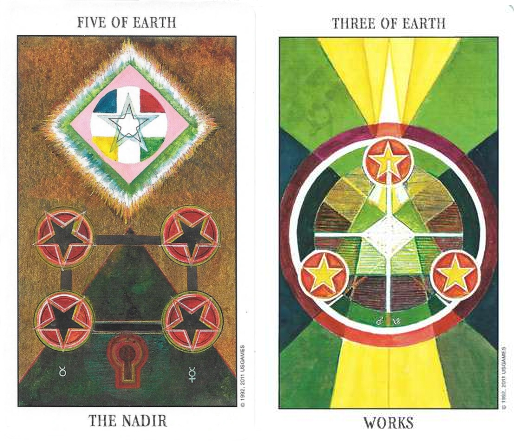
The "Five of Earth: The Nadir" reflected my worries about the future, and being stuck in a reality that didn't suit my needs.
The other card, "Three of Earth: Works" affirmed my feelings about my career path being right for me and helped me realize that if I want something I should go for it 100%.
After this, I went back to uni to study, and now I'm working at my dream job!
The making of Tarot of Traces
There comes a point in every Tarot-loving artist's life where they figure: "Why not make a card for fun?".
This is of course a gateway drug that gets them making card after card, with the inevitable end of making a deck out of them.
This is what happened to me. I made my first card on a whim, after listening to some Tarot-inspired music (it's everywhere!! guess all artists suffer from this problem...).
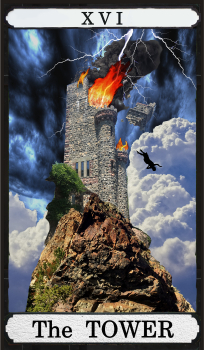
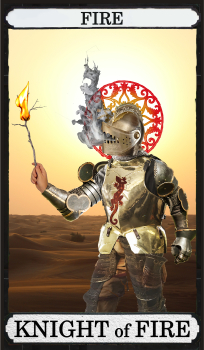
My first card was The Tower, inspired by the song "The Tower" by Güttinger.
Very imposing and such an iconic card, I've been drawn to it ever since my own towers came crashing down. The original version included lyrics, but I decided to make the design my own without words.
The next card was inspired by another song, "Knight of Wands" by Au Revoir Simone. After this, there was basically no stopping. Other people also really appreciated my cards, and kept pushing me to make more cards.
I figured it would be a nice project to tackle art block, and it's true that a defined project like this works really well to just make things.
Still, it was a pretty daunting task, having to make 78 different art pieces imbued with lots of symbolic meaning, and having to write up interpretations for each card (something I opted to do simultaneously, thankfully).
With my other decks to guide me on the meaning of each card, I started making them one by one. I opted to make them in order, unless I had specific inspiration for another card. Working through the minor arcana made me appreciate them as a sort of journey, like a winding road with triumphs and obstacles.
What comes next is of course making the cards real. People kept urging me to print them, and even worse, sell them... This is the part I always dreaded because I had no clue how to actually do this.
To quote boarboy, one of my favorite artists: "I’m not very good at money stuff or knowing how to sell stuff... It’s like I don’t have the right kind of brain for how to do it." I did want to at least try, because I had come so far with this project and I wanted to complete something for once.
I found a site where I could print a single deck as a prototype and made sure to make the booklet and box to go with the cards. This would be my prototype. It finally arrived, and it was so amazing to finally hold my cards in real life.
I gave this prototype a lot of test runs and worked a lot of issues with flow of the writing and technical stuff like card finish. I ended up giving away the prototype to my cousin who supported me throughout this project.
Next I ordered a new version which felt like the Beta version to me.
As you do with the Beta, you play test it!
I took it to work and did so many readings with my coworkers.
Again I worked out some kinks and after this I felt i was finally ready for the real deal.
I ordered a first edition print of 30 decks, hoping I could sell them all.
In the end, it took me about 3 years to finish everything, including cover art, boolet design and playtesting. It's probably the biggest project I've ever finished, and I'm immensely proud of my work.
If you've come this far, thanks for reading. If you have an interest in trying my deck online or want to order a copy, please check out the main Tarot of Traces page!
Tarot of Traces
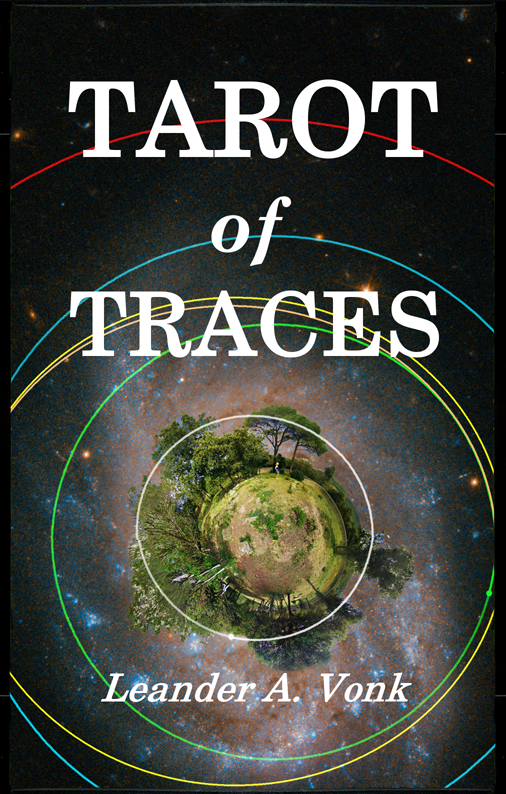
"The Tarot of Traces unfolds toward the reader. It is a life-affirming celebration of love and place that calls us through a blend of the sensory and archetypical.
At once otherworldly and rooted in the 21st century, each card overlays reality with dream and desire, memory and mystery, in shifting kaleidoscopic colour.
Tensions of juxtaposition and space join easily with traditions of elemental symbolism in this unique tarot deck.
The artistry in each card calls for pause and reflection, asking you to slow down and allow relation with the familiar and unfamiliar alike."
Tarot of the Spirit
By Pamela and Joyce Eakins
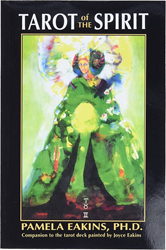
My first tarot deck, I inherited it from my mother. Since it's my first, and because it has sentimental value, it will always hold special meaning for me.
Despite my obvious bias, this is one of the more elaborate and inspiring tarot decks I've seen. Authored by Pamela Eakins (PhD), and illustrated by Joyce Eakins (MFA), two modern greats of the esoteric tradtion.
In general, this deck strays from the beaten path of the Raider-Wite-Smith deck.
It trades the traditional suits of wands, cups, swords and pentacles for the classical elements; Fire, Water, Air, and Earth.
Names of the Face cards are also changed to familial archetypes: Mother, Father, Brother and Sister.
I really like these changes. The deck feels at the same time both mystical and intimate, making it easy to create a connection with the deck.
Card art
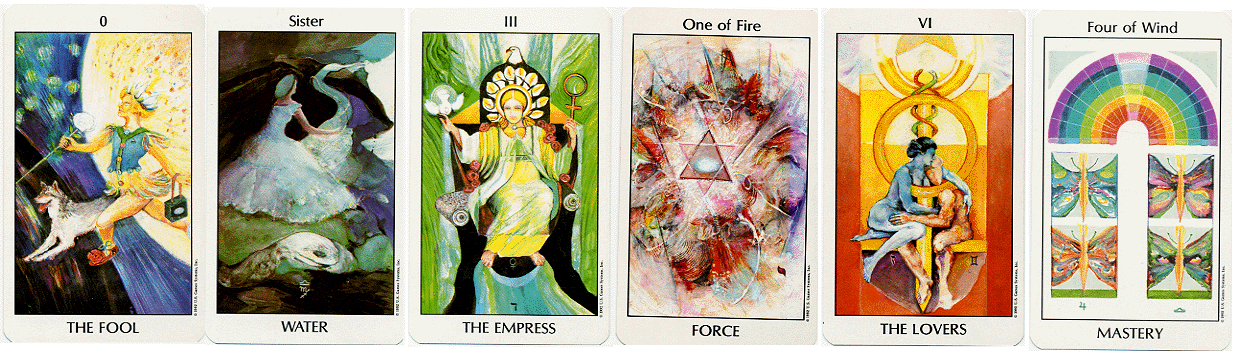
The cards are one of the most elaborate and detailed I've seen in any Tarot deck.
Each card was hand-painted in watercolor by Joyce Eakins, and this shows in the details found in each card.
The use of color is dramatic, and the composition of the scenes is deliberate, masterfully blending its abstract scenes and archetypical figures.
Given the background of the artist and author, it comes with no surprise that these cards are filled with symbolism.
Each card features alchemical, astrological and other esoteric symbols that tie the meaning of the card to the art.
For any deck, the art can make or break the experience, and this deck definitely makes the experience wonderful. A deck I use often, especially with people who are new to Tarot and want to have a full experience with it.
Readability
This deck (or at least the version I have) comes with a huge book that goes into the minute details of the tarot in general, esoteric traditions such as the Kabbalah, numerology and astrology, and so much more.
It features many spreads, and each card has a quick meaning, meditations, meanings and symbolism, and a longer explanation of the meaning.
This all makes it much easier to interpret the cards in a more personal or applied way, which gives it a big plus over other decks.
I've often used this book together with other decks just because the explanations are so elaborate.
The divinations are very inspiring, and always give you "ways out" of negative situations.
It offers up guidance and without sugarcoating finds a way to turn even the most negative cards onto a positive.
I prefer this type of deck, because nobody likes getting a bomb dropped on their mood and then having no cleanup after.
Playability
The only downside of this deck is that the cards are slightly too big to play nicely.
Especially if you have smaller hands, they can be hard to shuffle which makes it difficult to do a lot of readings in a row.
Other than that, the cards are very durable and scratch-resistant.
They also don't stick to eachother (this is a real thing some decks suffer from...) so spreading them on a table or in your hands works out nicely.
Thoth Tarot
By Aleister Crowley and Lady Frieda Harris
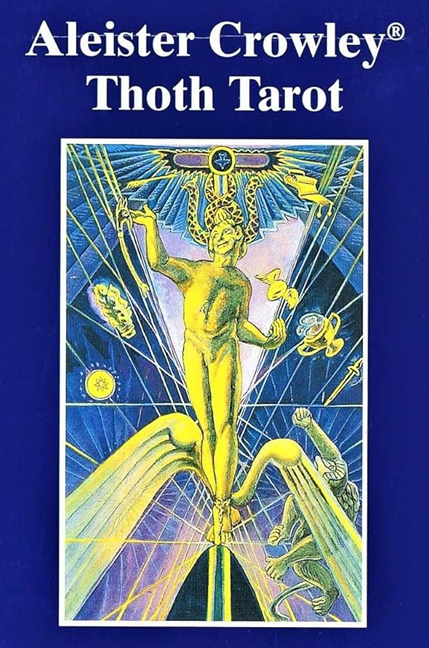
After playing with the spirit deck for a while, my mom and I wanted to get a new deck to see what other decks were like.
We also were trying to get my dad to join us, so we bought him a deck for his birthday.
This deck was much less elaborate, but the art featured on the box pulled us both in.
Created between the 30s and 40s of the 20th century by (in)famous occultist Aleister Crowley, the cards feature wonderful 20th century art deco designs and paintings by Lady Frieda Harris.
This deck does not adhere to the more mainstream Rider-Waite-Smith (RWS), and has several changes to it.
Namely, the Face cards of each suit are swapped around (with their meanings staying mostly the same), and names for some of the Trumps are also altered.
In general, this deck is very nice in terms of visuals, but has a few problems that make me play it less often.
Card art
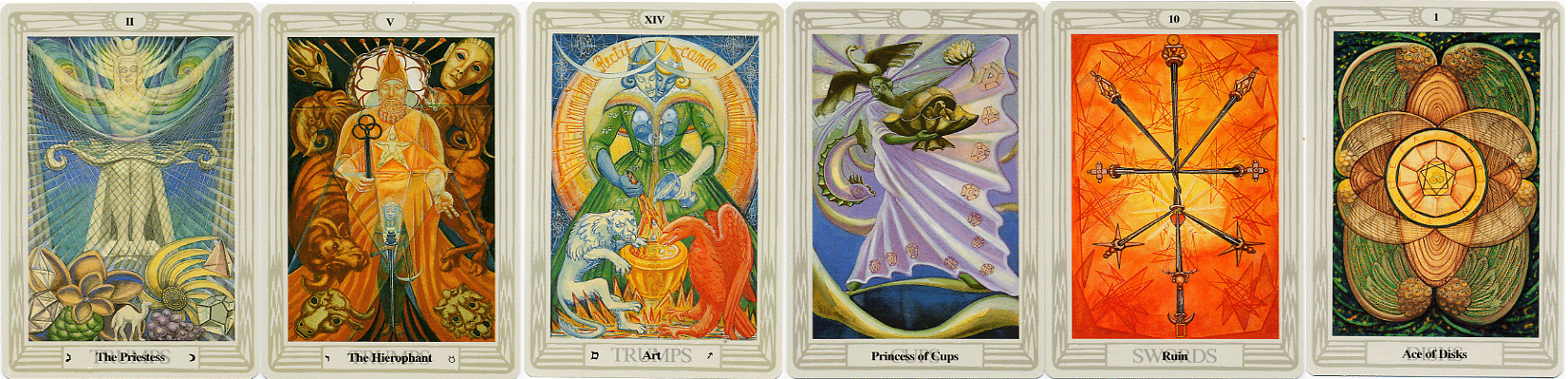
As expected from such an influential figure in the western occult tradition, this deck is extremely elaborate, but much more abstract than the RWS deck.
The card art features hand-painted watercolor illustrations by Lady Frieda Harris, an associate of Crowley's.
The imposing art deco artstyle reflects the darker nature of this deck, and each card is filled with occult symbolism.
While the art of the Major Arcana is easily recognizable, the same is not true for the Minor arcana.
The numbered cards are all named after concepts and feelings, and the accopanying art most depics abstract scenes.
This makes them a bit harder to "get" and less intuitive to interpret.
Readability
The version of this deck I have includes a small centerfold booklet with translated card meanings in Dutch.
There is apparently a larger book that goes along with this deck, but this is all I have to go off of.
I'm not sure what the original is like (knowing a bit about the author, probably similar enough), but these cards are significantly darker than the Spirit deck.
Where other decks are more vague in interpretations, this one is as direct as they come.
To quote a redditor: "Thoth deck's energy is very "you fucked around with this deck, now you're gonna find out the answer to your question, like it or not" ."
This aspect of the deck has kept me away from it as a beginner, since it's much too in your face about its answers.
Others do say it is one of the best decks for answering a yes or no question, and this I can see clearly.
Perhaps I have been too quick in my judgement and will have to give it a few more tries.
Overall however, the attitude of this deck is a bit much for a conflict-averse person like me.
Playability
The cards play well. They aren't too big, making them easy to shuffle and cut. Stickyness is also not an issue, since cards are nicely coated with a slippery layer.
The tiny booklet however doesn't have any special spreads for you to try, but this can probably be found in the bigger book that accompanies this deck.
The Wild Unknown Tarot
By Kim Krans
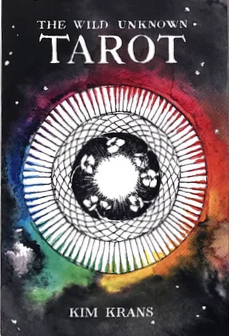
One day when I was out on the town in Toronto with friends, we visited several new-agey shops, looking at decks together.
If you've ever perused such stores, you know they are full of all sorts of Tarot decks (many being of ...questionable quality).
Among the many decks, I noticed this dramatically colorful deck. Looking through the cards, I immediately loved it.
Sadly, I didn't really have the money to buy it, since it was quite expensive. We left the store and went for lunch, and my friend left to go to the bathroom.
I thought nothing of it, but when she returned after a bit too long she was holding the deck.
She explained she just couldn't let me leave it in the store and thought I deserved to have it.
Because of this, this deck will always be special to me. It reminds me of selfless friendship, and this energy feels imbued in the cards now.
Card art
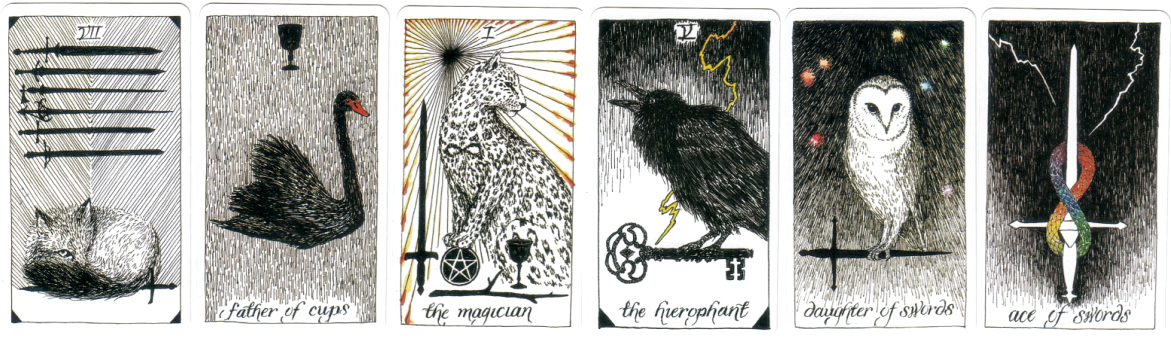
These cards are a lot more minimalist, but convey their messages quite clearly.
All cards feature scenes of nature and archetypical figures from the animal kingdom.
The art itself is minimalist in its color usage, with many cards being only black and white, making it that more dramatic when they do feature splashes of bright watercolor.
The contrast in its images makes for a very dramatic and evocative experience.
Coupled with the nature imagery, this makes the card meanings easy to convey in a quick glance, something that is always a plus when starting out with tarot reading.
Readability
What is nice about this deck is that it's quite beginner friendly.
The book goes into detail (with drawn instructions) on how to play, and offers up a bunch of spreads to do some deeper divination than just pulling a card or doing a past-present-future spread.
Each card has a dedicated page that tells you its meaning.
My only criticism is that a lot of space is used for this (having one page with a picture of the card, and one page for a short description), and it feels like there is a lot of empty space that could be used to go into the card meanings/divinations a bit deeper.
Sometimes, the descriptions feel a bit lacking and may not be clear enough for a deeper reading.
Despite this, it's a lovely little deck that is great for starting out.
If you're new to tarot and are looking for an all-round entry-level deck, this is definitely a recommended one.
Playability
This is where this deck sadly falls a bit short.
While the size of the cards is generally fine, the cards can be very "sticky".
Not sticky in a sense that they stick to your fingers, but more that thye stick together.
Probably something to do with the coating, but this kind of thing makes spreading out the deck very difficult.
It's hard to get that one card you have picked out, and cutting the deck is similarly annoying.
Joe Sparrow Tarot
By Joe Sparrow
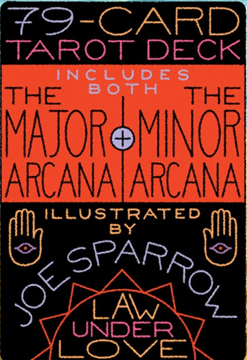
The first and only deck I bought for myself (something that is seen as kind of a no-no in some circles.). I'd been following Joe Sparrow for a while on Tumblr, when he started making this deck.
Starting out as a daily drawing project, seeing each card being made day by day was really special (and inspired the making of my own deck).
I was delighted to find out the deck would be printed for a limited run. As soon as they were available, I bought a set of cards for myself.
I don't use it as often nowadays, but It's definitely a great deck.
Card art
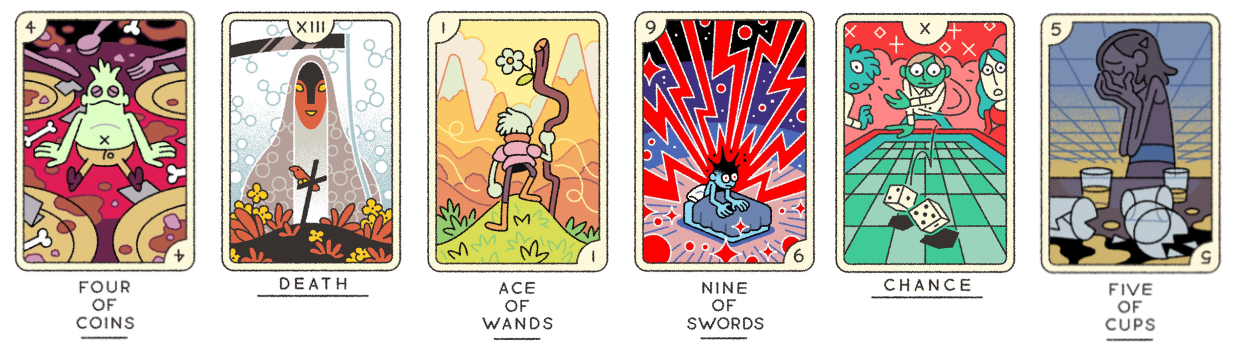
This deck stands out among the other decks I have, and among Tarot decks in general, because of the wonderfully whimsical and colorful illustrations.
Joe Sparrow is first and foremost an illustrator, and has a distinctive cartoonish style.
Although a style like this may be often seen as childish, it oddly fits the Tarot and does not dumb-down the message.
The cards are colorful, imaginative, and both minimalistic and elaborate at the same time.
Sparrow's imagination really shines here, as many of the cards have been re-imagined featuring modern scenes you wouldn't find in a traditional RWS-based deck.
This re-imagining coupled with the inspiring cartoonish art style truly makes this a deck for the modern age.
Readability
This deck sadly doesn't include any additional booklet or further explanations of the cards.
Joe did write one for each card, but they are super hard to find, as they can't be found in one place.
They aren't even on his website, instead only found on each card's corresponding tumblr post.
This makes doing actual readings with this deck much harder, because not having the author's interpretations makes them feel much more generic and hollow.
I'd love if the interpretations would be available somewhere, but alas.
Playability
Boy, however much I enjoy the art of this deck, it has one huge issue that keeps me from playing with it more often.
The cards are HUGE! Not only that, the aspect ratio is very different from other cards.
The cards are very wide, and combined with their size, it makes shuffling and handling them a nightmare.
Additionally, the deck was published in two versions.
One with all cards of the major and minor arcana included, and one splitting them into separate packs.
Combined with the relative unavailabilty of the card explanations, this deck is a bit annoying to play.
A shame, because the art is so wonderful.